BRF Hosts National Conclave on Atmanirbharta in Defence

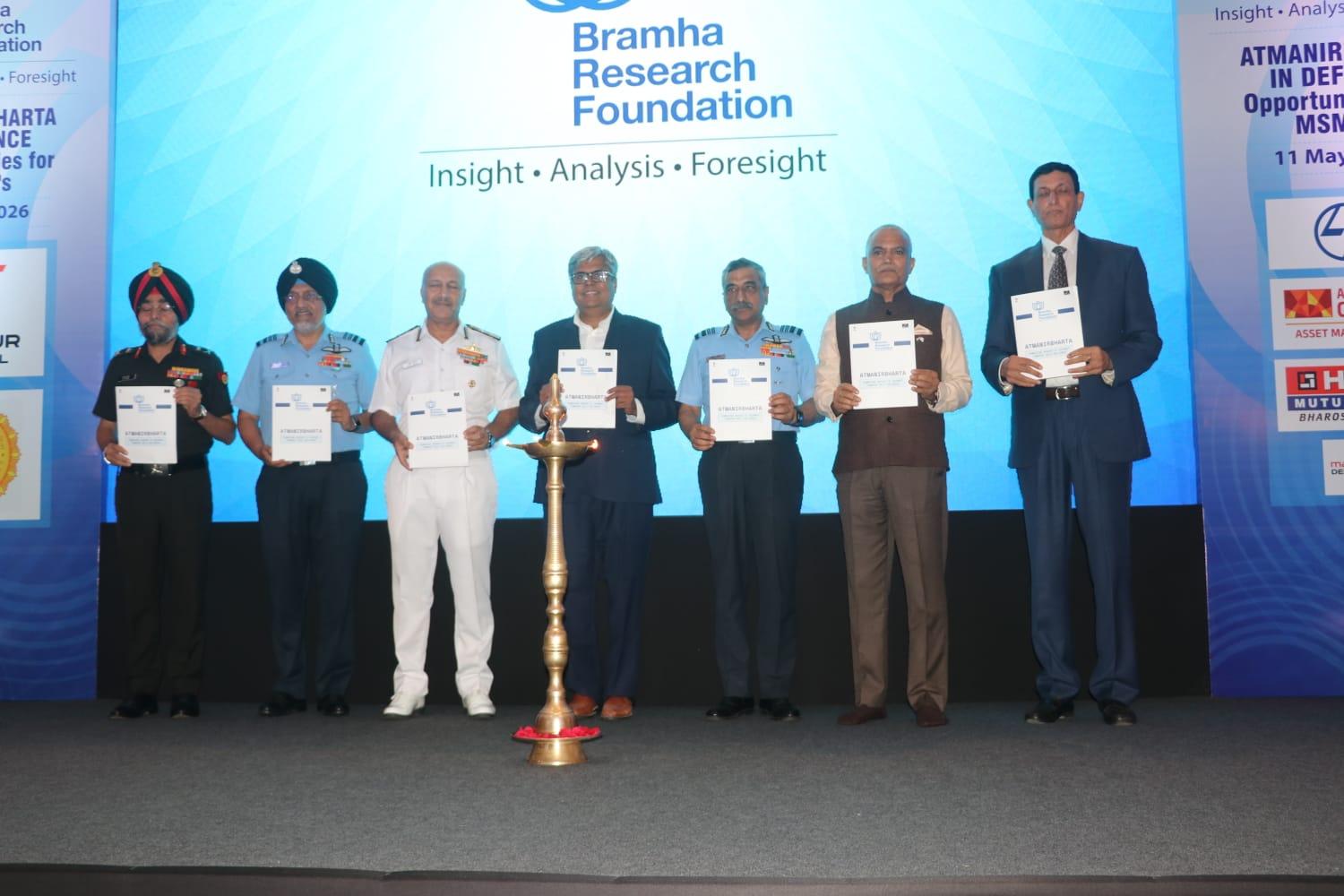 Bramha Research Foundation (BRF), with the support of the Indian Navy, hosted a high-level day-long conclave on ‘Atmanirbharta in Defence – Opportunities for MSMEs’ in Mumbai. The event brought together some of the nation’s most distinguished military leaders, policymakers, defence strategists, global OEMs and industry stalwarts to deliberate on India’s rapidly evolving indigenous defence ecosystem.
The conclave reflected on how indigenous systems such as BrahMos, Akashteer, and the Indianized Su-30MKI significantly strengthened Bharat’s strategic confidence and operational preparedness. The discussions underscored that Atmanirbharta in Defence is no longer merely an economic objective, but a strategic national imperative.
Delivering the inaugural keynote address, Air Marshal Ashutosh Dixit, Chief of Integrated Defence Staff, highlighted that India’s defence exports have now crossed INR 39,000 crore, while more than INR 5 lakh crore worth of defence projects approved recently carry a strong focus on Indian-made systems and indigenous manufacturing. He emphasized that strategic superiority will increasingly depend on resilient supply chains, rapid innovation, scalable manufacturing, and strong MSME participation.
Calling MSMEs the backbone of India’s future defence ecosystem, he urged them to evolve from vendors into long-term partners in national security.
Deependra Singh Kushwah, IAS Development Commissioner (Industries), & Chairman MAITRI, Government of Maharashtra, highlighted Maharashtra’s growing strength in defence and aerospace manufacturing. He shared that Maharashtra contributes nearly 30 percent of India’s weapons and ammunition output, hosts over 190 aerospace and defence startups, and is witnessing more than US$ 10 billion in committed investments in the sector. He also elaborated on the proposed Raksha Corridors, infrastructure expansion, and policy reforms aimed at making Maharashtra a leading defence manufacturing destination.
He also spoke about how future battlefields will be driven not just by conventional platforms, but by cyber, space, AI, communication systems, simulation technologies, and resilient supply chains. He underlined the vast opportunities emerging for MSMEs through indigenous manufacturing, upgrades, MRO, avionics, drones, radars, and next-generation defence technologies.
A thought-provoking presentation by Air Marshal Tejinder Singh focused on the rapidly evolving nature of warfare and the urgent need for India to accelerate indigenous capability development across aerospace and defence sectors. He highlighted how future battlefields will increasingly be driven by cyber capabilities, space technologies, AI-enabled systems, resilient communication networks, simulation technologies, and advanced manufacturing.
In a panel discussion on Atmanirbharta in Defence, Arun Ramchandani, Senior Vice President & Head (PES) IC, L&T, highlighted how strategic autonomy in defence can only be achieved through strong indigenous R&D, innovation, and scalable manufacturing ecosystems. He emphasized the need to integrate startups, MSMEs, and large industries into a collaborative defence ecosystem capable of building globally competitive technologies and platforms.
Biju George, Director, Shipbuilding, Mazagon Dock Shipbuilders Ltd MDL underlined the massive opportunities emerging for MSMEs in warship and submarine manufacturing, with over 200 MSMEs already contributing to key naval projects. He stressed the importance of long-term procurement visibility, faster payments, quality upgradation, and resilient supply chains to strengthen India’s indigenous maritime defence ecosystem.
Jitendra Gavankar, CEO, Safran India, spoke about the importance of balancing indigenization with international collaboration to build a sustainable and globally competitive aerospace ecosystem.
Khalil Rahman, CEO, TKMS India, emphasized that MSMEs will play a pivotal role in strengthening India’s submarine and maritime defence ecosystem through agility, innovation and rapid problem-solving capabilities.
Vice Admiral Atul Anand, Additional Secretary, Department of Military Affairs, highlighted the government’s strong push towards domestic procurement, defence innovation, and indigenous manufacturing. He highlighted how startups and MSMEs are becoming central pillars of India’s defence transformation.
Paresh Page, Director, BRF, noted that from AI and cyber security to drones, defence manufacturing, and resilient supply chains, the future of warfare and national preparedness will increasingly be shaped by technology, innovation, and indigenous capability.
He further highlighted that the extraordinary 34,000 percent growth in India’s defence exports over the past decade reflects Bharat’s emergence as a rising global defence manufacturing power under the visionary leadership of Hon’ble Prime Minister Narendra Modi.
He added that the vision of Atmanirbhar Bharat and India’s rapidly expanding defence ecosystem together represent nearly INR 10 lakh crore business opportunity for MSMEs across manufacturing, aerospace, electronics, drones, shipbuilding, cyber technologies, MRO, AI, and next-generation defence systems.
For more information: www.bramharesearch.org